Episodes 9 & 10: “Princess” & “Future”

All things must come to an end — but not without raising a little hell first.

The last two episodes of UnREAL season one (“Princess” and “Future,” respectively) play out like one movie-length episode. The finale gives some much needed closure on season-long character arcs — Rachel’s love triangle with Adam and Jeremy, Quinn’s future with Chet and Everlasting, which contestant actually wins Everlasting — as well as introduces new developments to be explored in the following seasons.

Television as a medium is pretty postmodern, especially considering how quickly its distribution and consumption have evolved in recent years. It’s rare that people watch shows week to week, let alone pay for cable. Instead the market has shifted to streaming — Netflix, Hulu, HBOGo, Showtime and tons more — to cater to the desperate binge-watcher.

This change in structure is integral to the conversation about television as a medium as well as the consumption of UnREAL over time. When UnREAL premiered in 2015, streaming sites were seeing their first real push. Netflix accounted for 50 percent of the 3 percent national decrease in television ratings that year alone. Netflix’s first original series House of Cards premiered in 2013 as one full binge-worthy season — comparable to the business model used today, only less saturated than 2018 standards.

Image result for unreal hulu
UnREAL moved from Lifetime to Hulu in 2018 for the fourth and final season.

But UnREAL was on cable in 2015, specifically Lifetime, so it relied on a week-to-week structure. At the end of “Princess,” Adam asks Rachel to run away with him. He’s sick of Everlasting and wants something — or more likely someone — real. But it leaves off with a cliffhanger — something almost foreign in modern television that’s written and conceived to be watched in a short amount of time. Consuming these two episodes back to back in 2018 seems natural because it’s considered the new standard — but audiences had to wait a whole week to see how the conclusion unfolded.

“Future,” starts with Rachel leaving Jeremy to run away with Adam — but he gets cold feet (in the form of Quinn pressuring him to finish Everlasting.) Rachel then comes back to the set of Everlasting similarly to how she came back in the first episode. Instead of “crazy is back,” she tells Quinn she wants to produce “the best finale in Everlasting history” with a wild smile and runny mascara. It’s a detail that makes Rachel’s cyclical arc of being tied to Everlasting and Quinn come full circle — and it’s easier to spot having seen all the episodes in a short amount of time.

Rachel and Quinn decide to make this episode unforgettable — and to get revenge from Adam and Chet, respectively. Rachel convinces Adam to pick Anna while also convincing Anna to dump him on live television — shattering his meticulously rebuilt image in seconds. Quinn produces one hell of an episode out of chaos — proving herself to be more worthy than Chet to Brad and the network.

The last scene of the season, however, caters to a building tension that can only be fostered in a week-to-week format. After being dumped and manipulated by Rachel, Jeremy takes drastic measures and goes to her emotionally abusive mother. Now that UnREAL is all on Hulu, the first inclination is to play the next episode and get that immediate satisfaction.

The season ends with Quinn and Rachel talking about their future, which seems just as dark and hopeless as their past — feeding into their toxic, tethered and inescapable relationship.

“Love is swell,” Quinn says with disdain. “But it’s not something you build your life around.”
Shiri Appleby on UnREAL and the “changing of the guards” in Hollywood

In 2015 Shiri Appleby became the face of UnREAL. As the show’s conflicted main character Rachel Goldberg, Appleby took a departure from the sci-fi world of Roswell and into a world that resembled her own — only a little darker.

Appleby is no stranger to the production of television shows — starting as a child actress in 1985 and working on shows seemingly nonstop ever since. But UnREAL let her sink into a role that reflected her long experience in television.

“I’m always looking for someone I can connect to,” Appleby said of playing the reality television producer. “Her world was a tad bleaker than my experience.”

Appleby wasn’t sure how audiences would initially react to Rachel’s character, especially since she was darker than comparable female television leads at the time.

“To me there was nothing wrong with Rachel,” Appleby said. “She was a product of circumstance. The show was a fight for her soul in a lot of ways.”

UnREAL deals with a lot of complex topics in its first season — from mental health to domestic violence and suicide — and Appleby wasn’t sure what storylines would connect well with audiences. It wasn’t until the season aired that she realized how deeply Rachel’s battle with mental illness resonated with viewers.

“I didn’t think it was going to hit such a nerve,” Appleby said.

This positive reaction was acknowledged and Rachel’s mental health battle later became the most developed narrative arc throughout the rest of the series.

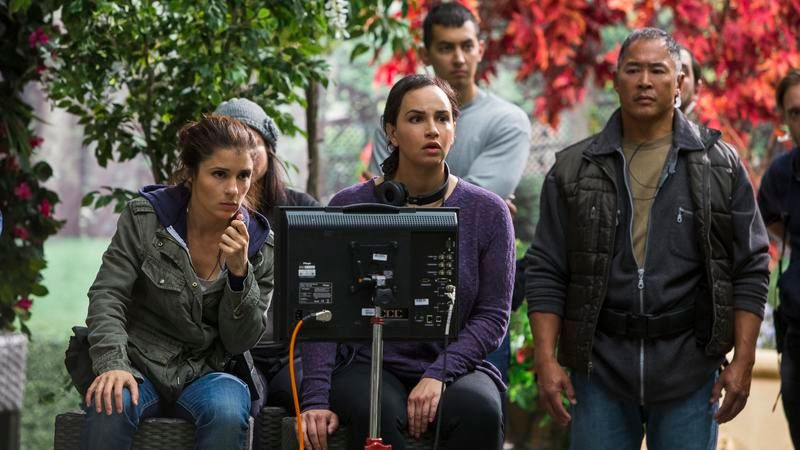
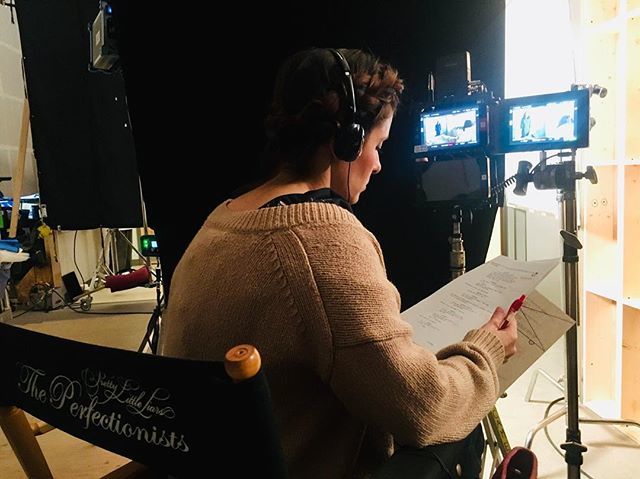
Shiri Appleby on set for Pretty Little Liars: The Perfectionists.

While Appleby was the face of UnREAL as the show’s lead actress, she was also given opportunities to direct episodes in the second, third and fourth seasons. Because she was so familiar with how the show works and the motivations of the characters, Appleby was able to direct with confidence and familiarity.

“I helped shape what the show was inevitably by being in every scene of it” Appleby said.

Even though it took a few seasons for Appleby to get in the directors chair in UnREAL, she has fully taken on the role for other shows. Appleby is currently directing episodes for Roswell: New Mexico and Pretty Little Liars: The Perfectionists and hopes to be part of a larger push for more female voices in Hollywood.

“I think there is a real thirst right now for female storytellers, female directors, female producers,” said Appleby. “People are actively looking for female voices — and if UnREAL was part of the conversation, even better.”

“From where I’m standing right now in this little Hollywood bubble, there is a changing of the guards happening right now,” Appleby said.

Episode 7: “Savior”

UnREAL has always been a show about powerful and problematic women. From Rachel’s role as a morally conflicted producer who still loves the thrill of manipulation to the less guilt-ridden Quinn — the women behind Everlasting are far from saints.

As producers, Quinn and Rachel exhibit a vast amount of power over the cast and crew of Everlasting. They’re not meek or shy — they’re depicted as take-charge women and “lady-bosses” trying to take on the man by climbing up the ladder. But their sense of power only does so much in the real world as they are fundamentally under subordination from “the man.” They are constantly challenged and taken down by Chet, Brad and the male executives at the network

In “Savior,” women are represented in some of the most problematic and complicated ways yet. After Mary’s death, Everlasting goes on lockdown and the crew deals with the investigation. Rachel is heavily questioned by the police because she invited Mary’s abusive ex-husband on set, which still consumes her with guilt. It’s then revealed that Shia was taking Mary off her meds without consent and getting her back on alcohol. Rachel wants Shia to go to the police but Quinn doesn’t let her — saying that she’ll take care of it.

Quinn takes on the role of the mother of the house, cleaning up the messes her girls made. Except instead of cleaning up champagne thrown by a pissed off contestant, she’s attempting to cover up potential murder charges.

Rachel is upset with Quinn’s plan to lie about the medication — until Quinn states that the show is bigger than her. 170 people will lose their jobs, many people who have families. This is a striking moment because it showcases the complexity of Quinn’s mindset. On the surface, their plan to cover up Shia’s interference with Mary’s medication is wholly evil. But Quinn sees this as the only option and that the ends justify the somewhat twisted means of getting there.

Image result for unreal episode 7 season 1

It’s clear that Rachel doesn’t think she’s as far gone as Quinn is — but they have very similar values. Rachel convinced herself that bringing Kirk to the set would be good for closure and for Mary. She brings Mary’s sister on to read a fake suicide note because she believes that will bring out the best ending for everyone. Like Quinn, Rachel is operating on a morally skewed framework that justifies bad behavior because she has good intentions.

During the investigation, Rachel films the contestants framing Kirk as an abuser that she can leak to feminist publications to get the show some moral high ground. When she interviews Adam, he calls her out on how manipulative this is and how she is the one who brought Kirk in the first place. He calls her a monster — which confirms what she already thinks about herself.

So what’s wrong with a woman being a monster, really? This type of representation can be seen as problematic — and it’s not not problematic. But it hearkens to the idea of the “burden of representation” — the idea that all representations of marginalized groups have to be squeaky clean and respectable in order to be legitimate. Otherwise, you’re just confirming hegemonic norms and stereotypes that are dangerous.

But this limits the range of what marginalized characters are allowed to be in media. If characters are polished and perfect they aren’t interesting. Complexity is fundamental to well-rounded character, and this is even more relevant with characters that have been deemed outside of the norm because of differences in gender, sexuality, race, disability and age. The characters of UnREAL don’t always have good reasons for their actions, but they are complicated and they often deal with a deep moral reckoning.

Episode 6: “Fly”

Whether you realize it or not, television acts to persuade the audience of a certain set of ideologies. Shows will integrate plot points and character motivations to make the audience have certain attitudes and beliefs towards a subject.

Ideologies are often defined as “normative” beliefs. They uphold the status quo of thought rather than challenge it and work in the interests of those in power. The guise of ideology effectively conceals the harsh truth of subordination — especially as it pertains to depicting dominant mindsets in media.

In UnREAL, the messages being told to the audience are deafening. They uphold patriarchal structures — often commenting on or dancing around them without actually challenging long-held beliefs. In “Fly,” the audience is told over and over again that women are not desirable when they’re older and that women must be in constant competition with each other to succeed.

“Fly” focuses on Mary, the designated “desperate MILF,” and her family date with Adam. Her entire characterization thus far has been seen as a joke — the producers don’t think a play-date with her kid will be sexy and are surprised she’s been kept on this long. Chet is the most surprised and makes a bet with Quinn that she won’t last the week. Quinn agrees while dealing with her own ageing and desirability to Chet — who is always seen with younger women.

While UnREAL has moments where older women are in power — like Quinn’s dominance as a producer and Mary’s moment in front of the mirror in lingerie — the show is constantly reminding the audience that older women can never compete with younger women. The rest of the contestants are perfect pictures of what America finds traditionally beautiful — and Mary is made out to be an outlier rather than a societal change of beauty standards.

The most inescapable message that “Fly” conveys is that women will always have to compete with each other and tear each other down in order to get ahead in a patriarchal world. This is seen in the competitions between Mary vs. Anna, Rachel vs. Lizzie and Rachel vs. Shia.

unreal 6

The case of Mary vs. Anna is the most obvious example of female competition as it pertains to Everlasting. To win his bet, Chet tells Anna to interrupt the family date and make it about her. Anna does, which sets off an already unstable Mary — making her seem crazy and jealous in front of America. Anna is then rewarded for this when she gets some one-on-one time with Adam.

The fight between Rachel and Lizzie happens behind the scenes. Both are desperately fighting for Jeremy’s attention — Lizzie, Jeremy’s fiance, starts comparing herself to Rachel and gets upset when he saves her from potential danger. Instead of being mad at Jeremy for having a wandering eye, most of her rage is pointed towards Rachel for being the object of that desire.

Lastly, Shia and Rachel have had a contentious competition that has largely been one-sided. Shia was upset when Rachel came back because she got relegated to a lowly producer with less trust from Quinn. In order to raise the stakes and get more drama than Rachel, Shia started giving Mary alcohol and switching out her medication. With the push from Quinn, Rachel decides to invite Mary’s abusive ex-husband to the date so she can get closure.

Both of these coincide at once which makes Mary lose her sanity. Shia, feeling guilt for her own role in this, puts the blame on Rachel for bringing Kirk. Shia is able to absolve her guilt somewhat by putting Rachel down.

Episode 5: “Truth”

In their critical-historical genre analysis of reality television, Heidi Penzhorn and Magriet Pitout identify four conventions of the genre. In order to be considered reality television, the show must maintain a focus on ordinary people, play into voyeurism, establish audience participation and attempt to simulate real life.

While UnREAL is not a reality television show nor is the fictionalized Everlasting both programs fall into these genre conventions in order to legitimize their performance both as a reality television show and a production of a reality television show.

UnREAL’s focus on ordinary people lies in Rachel, who acts as an audience surrogate and a symbol of normality in a highly fabricated and fanciful environment. In “Truth,” Rachel is the most human she’s been so far. She struggles with her role as a producer when Faith comes out to her in her hometown. Rachel teeters between wanting to show Faith’s story to a large, young audience who might want the representation and not wanting to force her out when she’s not ready or safe to be out.

Also in this episode, Rachel continues confusing relationships with Jeremy and Adam. What’s refreshing and relatable about Rachel is that she is deeply human almost to a fault. She makes bad choices and does things she regrets often motivated by her declining mental health and problems with alcohol and human intimacy. She tries to sleep with Jeremy during the hometown date even though he’s engaged and their previous relationship exploded to no avail. She chooses not to sleep with Adam, even though she wants to, as she becomes cognizant of her profound ability to make mistakes. The last scene of the episode shows Rachel in her trailer masturbating to a video of her and Jeremy in Mexico.

unreal.gif
I couldn’t find this GIF so I had to make it. I’m going to hell!

Voyeurism plays a large role in UnREAL and the production of Everlasting. There are cameras stationed in every contestants room and producers as well as the audience at home looks upon these people through various screens. In this episode, the audience watching UnREAL sees snippets of Rachel and Quinn’s personal lives which is arguably just as voyeuristic as the fictional audience watching the intimate lives of the cast of Everlasting.

Audience participation is revealed for the first time this episode when a conflict with an entertainment magazine arises. Before this episode, the production of Everlasting rarely regards the world outside of their manufactured bubble. But as the show is filmed week to week, press coverage can make or break the narrative the producers are trying to weave together in real time. This relationship with the press becomes more tense over time when much more dark situations happen on and off screen.

Lastly, both the production of Everlasting and UnREAL try to simulate reality and make the audience forget what they’re watching is scripted. In Everlasting, they try to establish reality by taking away the fancy sets and costumes and bringing Adam to Faith’s hometown. In UnREAL, we see beats from characters when they’re not “on-camera,” like Graham’s relief moment with a recently eliminated contestant, to make it seem like they exist in a state of reality outside of Everlasting.

Episode 4: “Wife”

The fourth episode of UnREAL season 1 ties up some early plot points while others finally start to ramp up in intensity. In film and television, narrative is often conveyed through beats and arcs. Beats exist as shorter scenes, interactions and moments that feed into a larger narrative while arcs tend to follow a character’s progression over a longer period of time.

Beats exist for the audience to understand what’s going on in the narrative. In television, beats take the form of a short recap before an episode. These “previously on…” segments are popular among shows that have various interweaving story lines especially when they are being watched week to week rather than “binged” in one shot.


In “Wife,” the recap reminds the audience of moments from earlier episodes that will come to fruition: Adam’s demand to have a date in his winery from the pilot, Shamiqua and Athena’s conflict of Black identity from episode 2, as well as the relationships of Chet and Quinn and Rachel and Adam.

UnREAL plants the seed of Adam’s romantic winery date in the pilot as he demands to have it put in his contract to incentivize him staying on the show. When the date finally comes, Rachel finds that the winery is a dump and needs to be fully transformed in order to be television fantasy ready. It’s also revealed that Adam has invited potential investors to the taping of the date which ties into his character arc of using the show to build his financial empire without the help of his father.

Unreal Shiri Appleby GIF
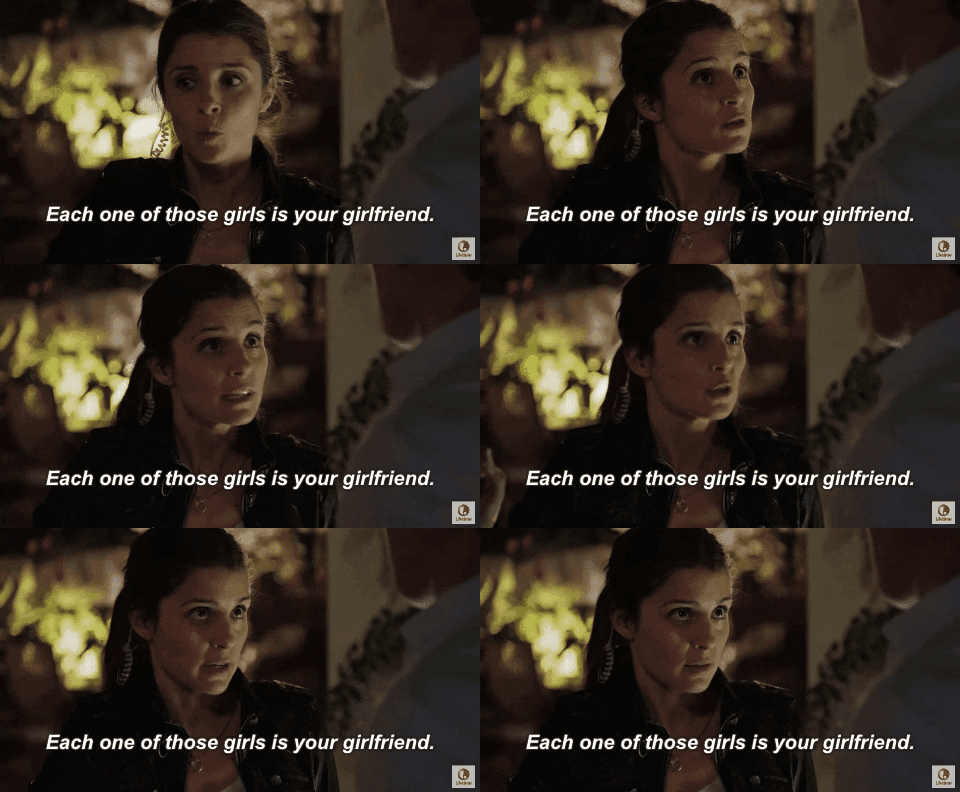
Rachel makes Adam apologize to the contestants for being unfaithful.

As his producer, Rachel spends most of her time cleaning up Adam’s messes. Rachel has to make Jeremy and the crew clean up the property and she calls in a favor from Chet to turn the power back on in the winery. While they have a producer/unruly reality star dynamic there’s also a very real will-they-won’t they relationship between them. In previous episodes, Adam has openly flirted with Rachel and Rachel’s character arc doesn’t lend to her being morally above sleeping with the suitor.

This tension culminates when Adam kisses Rachel on the cheek on set each small moment between them builds and builds over the course of the season until it feels like one of them has to give in to the temptation.

Also in this episode, the battle between Shamiqua and Athena comes to a close. In the second episode, Jay has a talk with the contestants about how Black women do not make it far on Everlasting. Athena decides to perform as a loud, opinionated stereotype while Shamiqua holds true to her values. Athena tries to make a deal with Adam to keep her to the final four, but is ultimately eliminated at the end of the episode.

Finally, Chet and Quinn’s relationship comes to a standstill. Quinn decides she’s tired of being second best and goes out with an old flame who helped her create Everlasting. They decide to pursue a lawsuit that claimed Chet stole the show from them, which raises the stakes of Quinn and Chet’s personal arcs as well as their relationship.

Episode 3: “Mother”

Formal analysis of any given show requires an understanding of how a show looks — and how that look signifies meaning and emotion. The visuals of a show — from the look of the physical set to how the show is presented through shot and editing choices — plays a large role in the show’s meaning. For shows that are reliant on a specific time period like Mad Men or The Marvelous Mrs. Maisel, deliberate choices are made to ensure that the audience can get a feeling of the decade it’s set in. This specific look is then integrated into the framework of the show and becomes something that is not just a sign of that time — but also familiar.

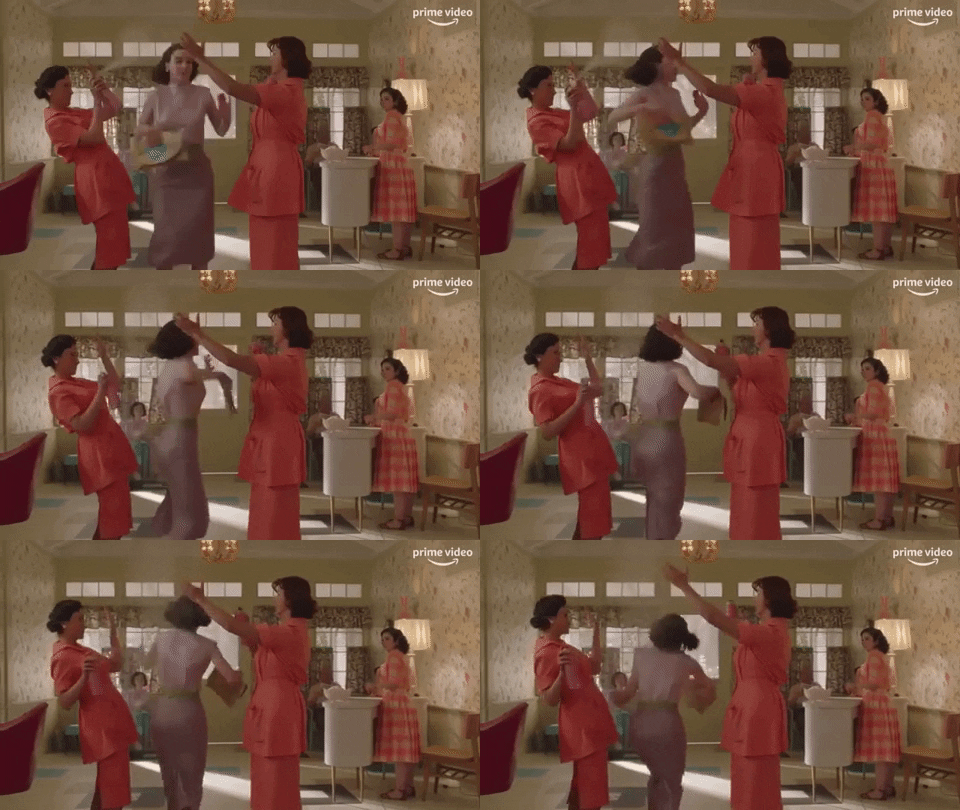
season 2 spin GIF by The Marvelous Mrs. Maisel
The Marvelous Mrs. Maisel implements 1950s femininity and style.

In the case of UnREAL, the production has to include props, shots and setting choices that will signify to the audience that the characters are producing a reality show within the narrative framework. Because of this, there are several shots that reveal the constructed reality of the production of Everlasting – fake camera operators, cranes, lights and sound crew and production staff — and they add to the ethos that what you’re watching is a production of a television show rather than a production of a production of a television show.

The filming choices in UnREAL are thematically interesting because there is a lot of watching. Many of the scenes cut back to a control room, where Quinn and other producers look at what’s happening on the set of Everlasting. There are cameras everywhere, which lets both the audience and the fictional production staff lean into a tempting voyeurism. There are even elements of voyeurism and this sense of watching when the cameras are “turned off” in the fiction of the show. The episode “Mother” starts with Rachel catching Adam in the act with one of the contestants. And Rachel doesn’t really catch him — she watches through the coat rack, and the camera follows a similar, voyeuristic gaze, until Adam notices her watching and feels embarrassed.

s01e03_101.jpg

While watching UnREAL, one is constantly reminded that everyone is being watched in one way or another. For the contestants on Everlasting, they’re being looked at by the producers and the audience at home. For those behind the scenes — the audience gets to see them when they think they’re not being watched because of the fictionalized nature of the production. This unnerving sense of voyeurism carries through the plot — and it’s only as effective as it is because its show within a show format is able to manufacture tension and emotion through visual choices.

Episode 2: “Relapse”

Are there auteurs in the world of television? The term, originally popularized in France during the French New Wave, stated that the best directors have to have a complete authorship and vision for their work. Someone who has a technical ability to direct, incorporates their own unique stylistic choices into the project and paints a portrait into their worldview. In American cinema the auteur label is associated with the likes of Alfred Hitchcock, David Lynch and Paul Thomas Anderson.

But it’s hard to pinpoint one specific auteur in television shows. This is mostly due to structural differences between the media. While many people have their hands in the production of a film — most influence is derived from the director and the screenwriter. The director is the one credited with the vision — using the screenplay along with their expertise and personal style to make something that echoes what they want to say.

Related image

Conversely, television is much more collaborative. There’s not a single writer, there’s a writers room. And directors rarely stay on for a whole season, with most television shows alternating different directors each episode.

But that isn’t to say auteurs cannot exist in television — they simply differ from those roles within film. Because auteurs are concerned with the long-standing vision of a work — it’s unlikely they will take the forms of directors or writers. Instead, television auteurs can exist as showrunners, producers and even lead actors.

UnREAL was co-created by Sarah Gertrude Shapiro and Marti Noxon. Noxon is a television drama powerhouse — boasting credits like executive producer for Buffy the Vampire Slayer, consulting producer for Mad Men and most recently executive producer for Sharp Objects. Shapiro, on the other hand, wore several producer hats on The Bachelor over the span of two years. Together they acted as auteurs for Lifetime with their differing industry experiences and thematic styles to create a unique voice for the series.

In “Relapse,” the show takes a more serious route than the introductory pilot. The episode deals with darker themes — the death of a contestants father and a competition to create a new villain for a cash bonus. The tone can be credited to director David Solomon and writer Elizabeth Benjamin. Solomon is most known for producing and directing Buffy the Vampire Slayer and Benjamin has written for Law & Order: Criminal Intent, Bones and 13 Reasons Why.

season 1 lifetime GIF

It’s also possible for actors to be auteurs in television — especially since they are involved for long periods of time and are effectively the face of the production. I Love Lucy’s success is credited to several people — but it wouldn’t be what it is now without the influence and charm of Lucille Ball.

UnREAL is a show-within-a-show, following the production of Bachelor parody Everlasting. In the case of Everlasting, Quinn King serves as auteur. The showrunner tactfully manufactures every second of footage to create the most watchable show, no matter how unethical it may be. While she often makes someone else carry out her vision for her — the vision is ultimately her own. And Everlasting perfectly encapsulates how Quinn sees the world — an America built on exploitation, pessimism and shameful temptations.

Episode 1: “Return”

Lifetime’s UnREAL follows the production of Everlasting — a reality dating show where twenty girls claw, drink and fuck their way to the heart of an eligible suitor. The pilot episode “Return” starts with the newest season of Everlasting and a new suitor — a British hotel heir named Adam Cromwell. At the helm of Everlasting is Quinn King, a showrunner with a skewed moral compass and a compulsion to make good television no matter the consequences.

“Return” is littered with new contestants and producers. That is until Rachel Goldberg comes back — a producer who received lawsuits from the network and potential jail time after having a mental breakdown during the previous season’s finale. Quinn brings Rachel back to the show, despite the dismay from the production team, because she’s the best of the best.

UnREAL makes it clear that reality television like Everlasting is anything but reality. Good television is fulfilling a fantasy rather than catering to realism. The producers have to prod contestants to get dramatic reactions — and they’re incentivized to do so. Quinn promises cash bonuses for nudity, 911 phone calls and cat fights. If you have a good sense for drama, the more she trusts you.

unreal constance zimmer GIF
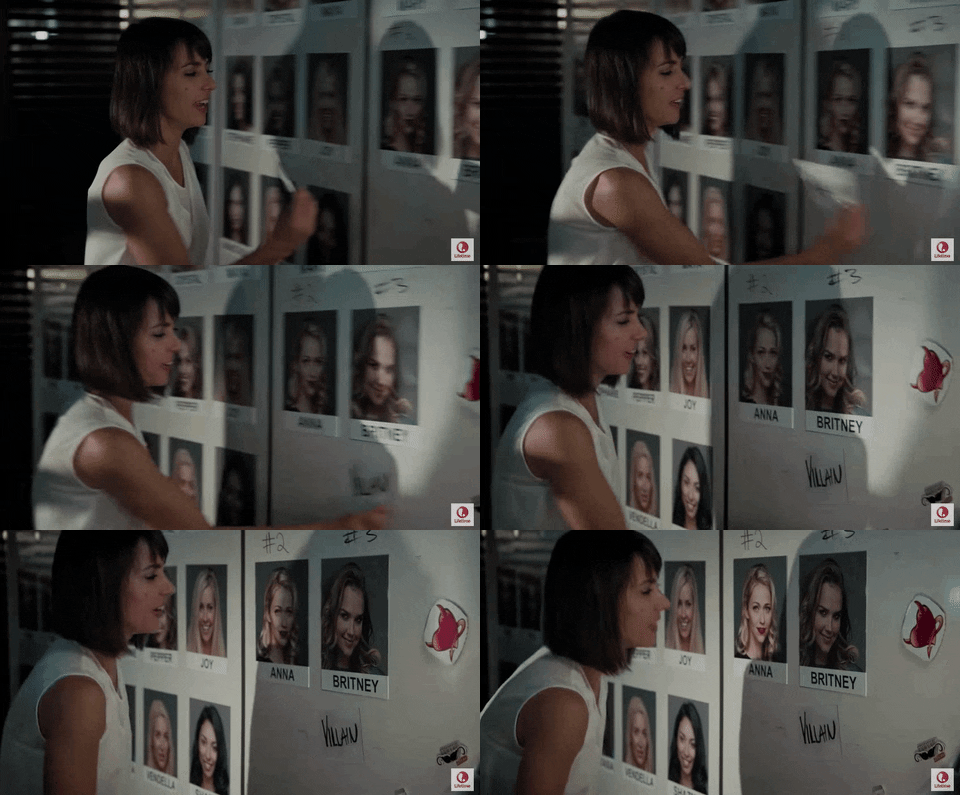
Quinn marks Britney as the season’s “villain.”

The contestants on Everlasting are fabricated — categorized into easily recognizable roles like “wifey,” ‘villain,” “desperate MILF” and “virgin.” Even Adam is using the show to reshape his star image after he partied with strippers in his family hotel chain, resulting in a PR nightmare that can turn around after spending “a couple of weeks on the cover of Us Weekly.”

“Return” is pretty upfront, if not extremely heavy handed, about the construction of fantasy in reality television. But it has a lot more to say about feminism, power and problematic women.

Quinn is a powerful woman. She runs a highly popular television show and has control over every contestant, producer and second of footage. Because she’s been in the reality television framework for so long, she’s desensitized to the consequences of her actions. She brings on Faith, a contestant described as a “horse faced virgin,” as a joke. Because how could a suitor like Adam Cromwell entertain the idea of Faith being desirable?

Image result for unreal faith
Adam and Faith have a one-on-one.

Part of Quinn’s problematic power comes from Rachel. While she is not as giddy as Quinn to ruin these women’s lives, she’s naturally good at it. A contestant like Mary, the “desperate MILF,” confides in Rachel about her hesitations and her experience with abuse because she’s seen as trustworthy. Rachel creates a false sense of trust for her own gain, donning a “This is What a Feminist Looks Like” t-shirt.

It’s not secret that UnREAL is commenting on The Bachelor. In 2015, America was re-surging it’s already long love-affair with reality television. The Bachelor became a show that wasn’t just something you watched shamefully — you hosted watch parties and made fantasy drafts. And by having a former Bachelor producer on board — UnREAL was able to comment on our cultural obsessions with constructed reality.